The founding year is supplied in the brand configuration and anchors this site’s company narrative. It is not presented as evidence for a specific product release, test report or certification event.
Configured founding year · 1984
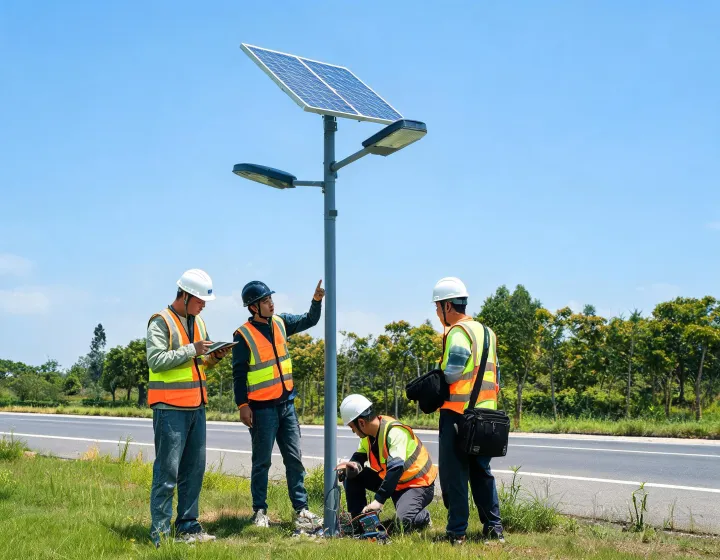
Sunna Design Connects Field Conditions to Project Records
Outdoor lighting decisions remain useful when the site assumptions and responsible roles stay visible.
Scale described without overstating scope
Configured experience spans roadway, area, public-space and autonomous solar lighting discussions. Every current project still requires fresh site inputs and model-level documentation.
Geographic reach increases the importance of local solar resource, electrical rules, environmental exposure and approval scope. A credential listed for one version is not automatically applied to another destination.
Organizational scale supports engineering, commercial, logistics and service roles. Named ownership within the project remains more useful than a company-wide number when an issue needs resolution.
Three operating principles
Measure the actual site
Pole locations, road geometry, activity, shading, wind and access define requirements that a generic product claim cannot replace.
State the calculation basis
Photometric and autonomous-energy results are linked to files, coordinates, schedules, temperature assumptions and maintenance factors.
Preserve configuration identity
Drawings, controls, batteries, optics and compliance documents are tied to the system that moves into procurement and handover.
Roles from survey to handover
Application engineers translate road classification, pedestrian use, sports activity or public-space priorities into measurable lighting criteria. Photometric specialists review luminous flux, candela distribution, mounting height, uniformity and spill. For autonomous systems, energy specialists compare solar resource and load profiles under documented assumptions. Project coordinators connect the resulting configuration to commercial scope and delivery records.
High luminous efficacy can reduce electrical demand, yet distribution, glare control and visual comfort may justify another optical balance. Integrated systems can control interfaces and simplify installation, while serviceable batteries, drivers or light engines may reduce future replacement scope. Centralized monitoring offers common oversight, whereas distributed controls can maintain local operation and isolate faults. None of these choices wins without context.
UL, CE and RoHS are used only because they appear in the supplied configuration. Their applicability is checked by product, market and current documentation. An IP rating addresses defined ingress testing but does not prove corrosion resistance, wind loading, battery performance or suitability for every orientation. A solar autonomy calculation depends on location, shading, temperature, component aging and the programmed dimming schedule.
These limits are part of professional disclosure. A field sample can demonstrate construction, distribution and control behavior under stated conditions; it cannot reproduce every season, maintenance lapse or long-term component cycle.
Review the evidence behind the layout.
Bring the survey, calculation basis and project milestone.